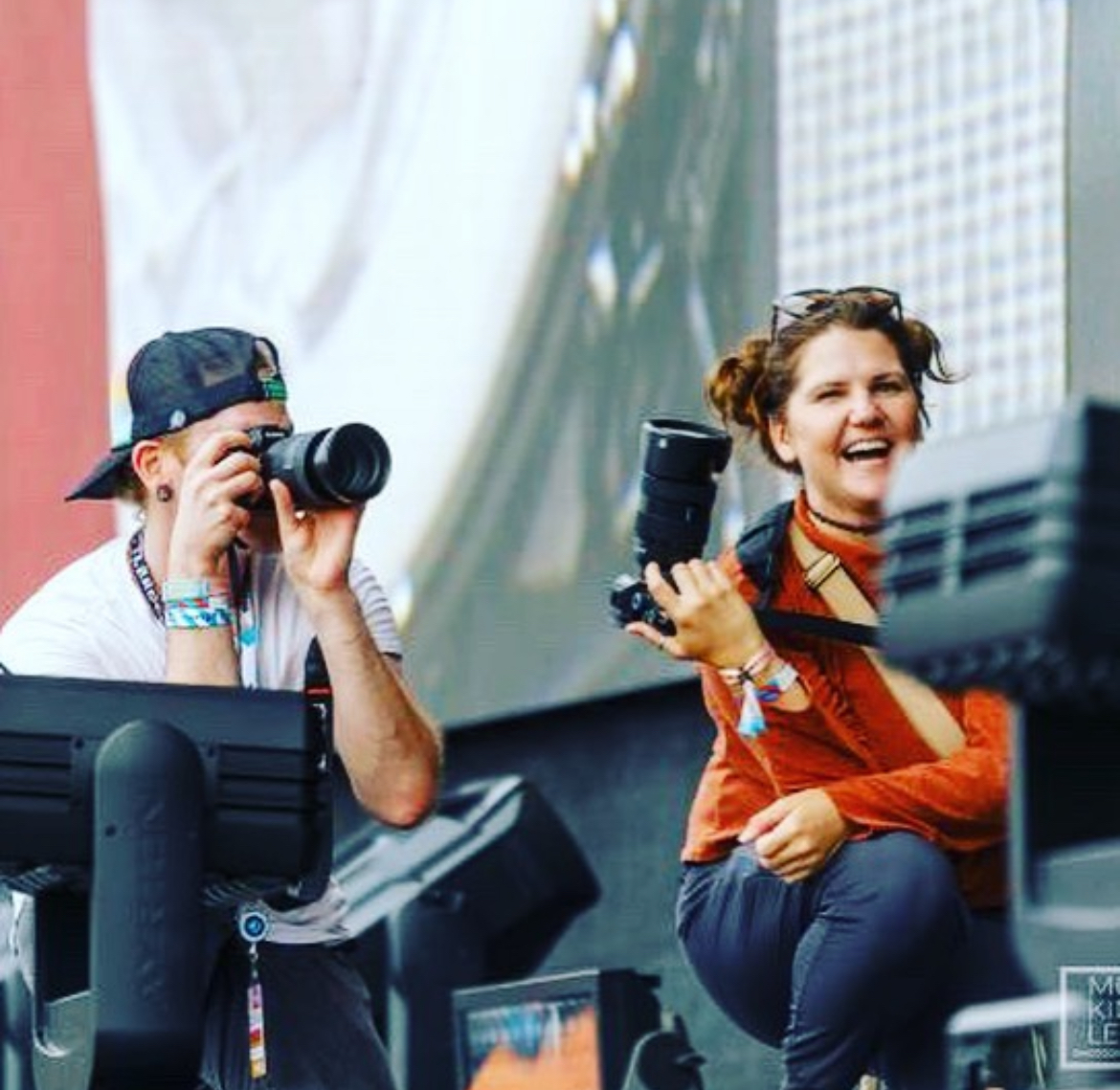
I use Sony cameras for concerts, editorial portraits, documentary work, events, and video.
My kit gives me enough range to move between a dark venue, a backstage room, a bright outdoor festival, and a planned portrait session. I care about sharp images and reliable equipment, but I also need gear that lets me move quickly.
Here is what I use and why each piece has earned a place in my bag.
My camera bodies
I work with a Sony a7IV and a Sony a7III. Both are full-frame mirrorless cameras.
The Sony a7IV is my main camera. I use it for photography and video because it gives me strong image quality, dependable autofocus, and enough flexibility for different assignments.
The Sony a7III is my second body and backup.
Using two camera bodies saves time during concerts and events. I can keep a wide or standard lens on one camera and a telephoto lens on the other. Instead of changing lenses in a crowded pit, I can switch cameras.
That matters when I only have three songs to photograph a band.
A second body also protects the assignment. Cameras are machines, and machines can fail. I never want one equipment problem to end a paid shoot.
Sony 35mm f/1.8
The 35mm is one of my favorite lenses because it feels close without feeling too tight.
I use it for backstage photographs, artist portraits, documentary moments, small venues, and environmental images. It shows the person while keeping enough of the location to tell the viewer where they are.
The f/1.8 aperture also helps in low light. I can photograph in dark rooms without pushing the camera settings too far.
This lens works well when I want the viewer to feel present in the scene.
Sony FE 20mm f/1.8
The 20mm is my wide lens.
I use it when I want to show the scale of a venue, the energy of a crowd, or the full environment around an artist. It is helpful in tight backstage rooms where I cannot physically move farther away.
Wide lenses can easily distort people, so I pay attention to my angle and where I place the subject. When used with care, the 20mm creates images that feel immediate and full of movement.
It is also useful for video, travel work, and wide establishing shots.
Sony FE 70-200mm f/2.8
The 70-200mm is one of the most useful lenses in my concert kit.
It lets me photograph artists from farther away while still creating close, detailed images. I use it at festivals, larger venues, ceremonies, events, and any assignment where I cannot stand near the subject.
The f/2.8 aperture helps in low light and creates a soft background when I want the subject to stand out.
This lens is larger and heavier than the rest of my kit, but the range is worth it. It gives me several framing options without forcing me to move across a crowded space.
Sony FE 50mm f/2.8
The 50mm gives me a natural view that works well for portraits and details.
I use it when I want less distortion than a wide lens but do not need the distance of the 70-200mm. It is helpful for close details, products, hands, clothing, equipment, and quieter portrait moments.
A 50mm lens is simple, but simple is often useful. It keeps me focused on the subject instead of trying to force a dramatic effect.
Sony 24-70mm f/4
The 24-70mm is my flexible event lens.
It covers wide photographs, medium portraits, and tighter frames without a lens change. I use it when I need to react quickly and do not know exactly how much room I will have.
The f/4 aperture does not bring in as much light as my faster lenses, so I may not choose it for the darkest concert venues. It still works well during daytime festivals, events, travel assignments, and controlled portrait sessions.
When I need one lens to handle several jobs, this is often the easiest choice.
Lighting and support gear
Natural light is great when it works, but I do not build my entire process around luck.
I own compact lights, reflectors, and flashes for portraits, events, interviews, and video work. Small lights are easy to carry and can make a major difference in a dark room.
Reflectors help soften shadows or return light to a person's face. Flashes give me more control when the available light is weak or uneven.
I keep the setup simple whenever possible. Too much equipment can slow down a session and make people uncomfortable. I use enough light to improve the image without turning every location into a full studio.
My gimbal stabilizer
I use a gimbal for smooth video movement.
It is helpful when I am walking with an artist, filming venue footage, creating behind-the-scenes content, or capturing movement during an event. Handheld video can work well for a rough documentary style, but some projects need a cleaner look.
The gimbal gives me that option without requiring a large crew.
Storage and editing equipment
The shoot does not end when I leave the venue.
I use my own computer and hard drives to organize, edit, back up, and deliver every project. File storage may not be the most exciting part of photography, but it is one of the most serious parts of the job.
I keep multiple copies of important work. A camera card is not a long-term storage plan.
Good file management protects the photographs and helps me deliver them on time. Clients trust me with moments they cannot recreate, so I treat their files with care.
How I choose what to bring
I do not carry every piece of gear to every shoot.
For a concert, I may bring both camera bodies with the 35mm and 70-200mm ready to go. For an editorial portrait, I may use the 35mm or 50mm with a compact light and reflector. For video work, I may add the 20mm and gimbal.
The location, lighting, schedule, and final use of the images all shape the kit.
More gear does not guarantee better work. Sometimes it creates more choices than you need.
I would rather bring a focused kit, understand each tool, and stay present while I work. The camera should help me notice the moment. It should never distract me from it.
← Back to Journal